Results in motion
Try-on beyond the studio.
Real-world motion, cluttered backgrounds, and diverse garments—all evaluated as videos, not isolated frames.
Overview
Training data that matches the real task.
TripVVT connects a large-scale triplet dataset, a stable spatial prior, and a challenging video benchmark in one research stack.
Video virtual try-on still struggles outside curated scenes because large-scale in-the-wild triplet supervision is scarce and fine-grained garment masks are fragile under motion, occlusion, and clutter.
We introduce TripVVT-10K, a dataset with explicit video-level cross-garment supervision; TripVVT, a Diffusion Transformer baseline that replaces garment masks with a stable coarse human-mask prior; and TripVVT-Bench, a 100-case evaluation suite spanning video quality, try-on fidelity, background consistency, and temporal coherence.
Across academic and commercial comparisons, TripVVT improves video quality and garment fidelity while generalizing more reliably to unconstrained videos. The dataset and benchmark are publicly released to support reproducible progress.
01 · Dataset
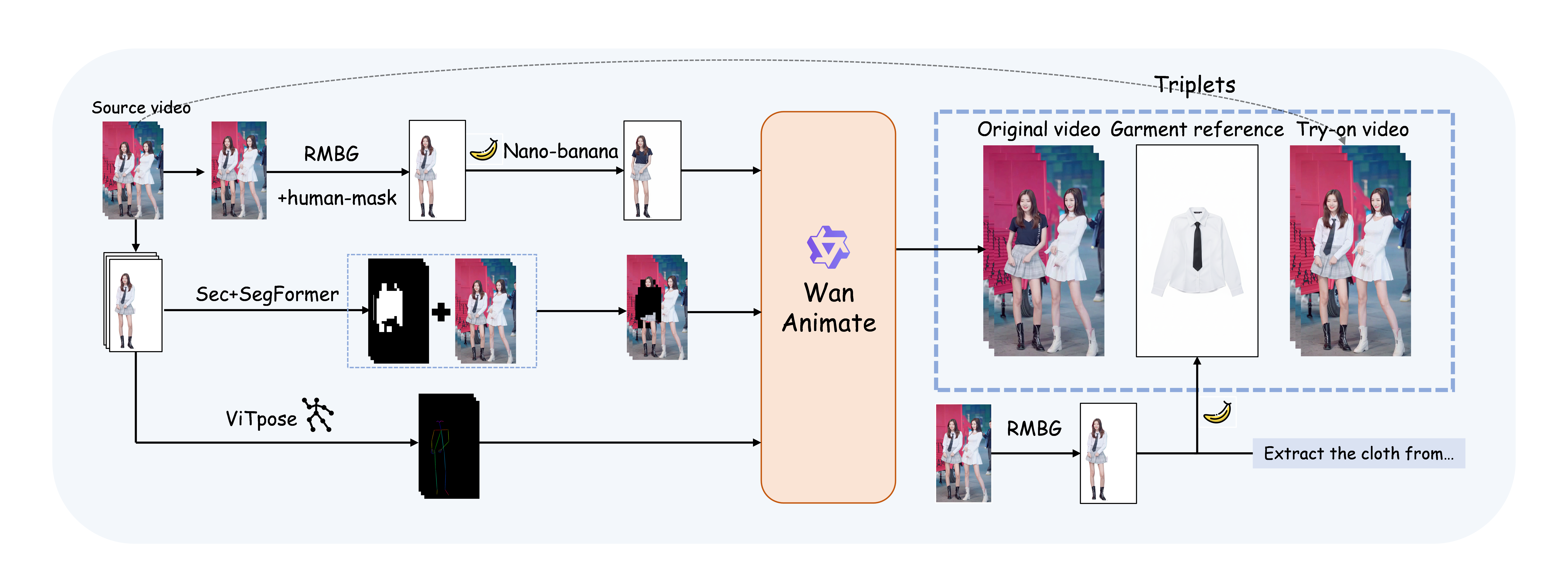
From wild videos to supervised triplets.
TripVVT-10K turns unconstrained source videos into aligned training triplets while preserving motion and scene diversity.
02 · Method
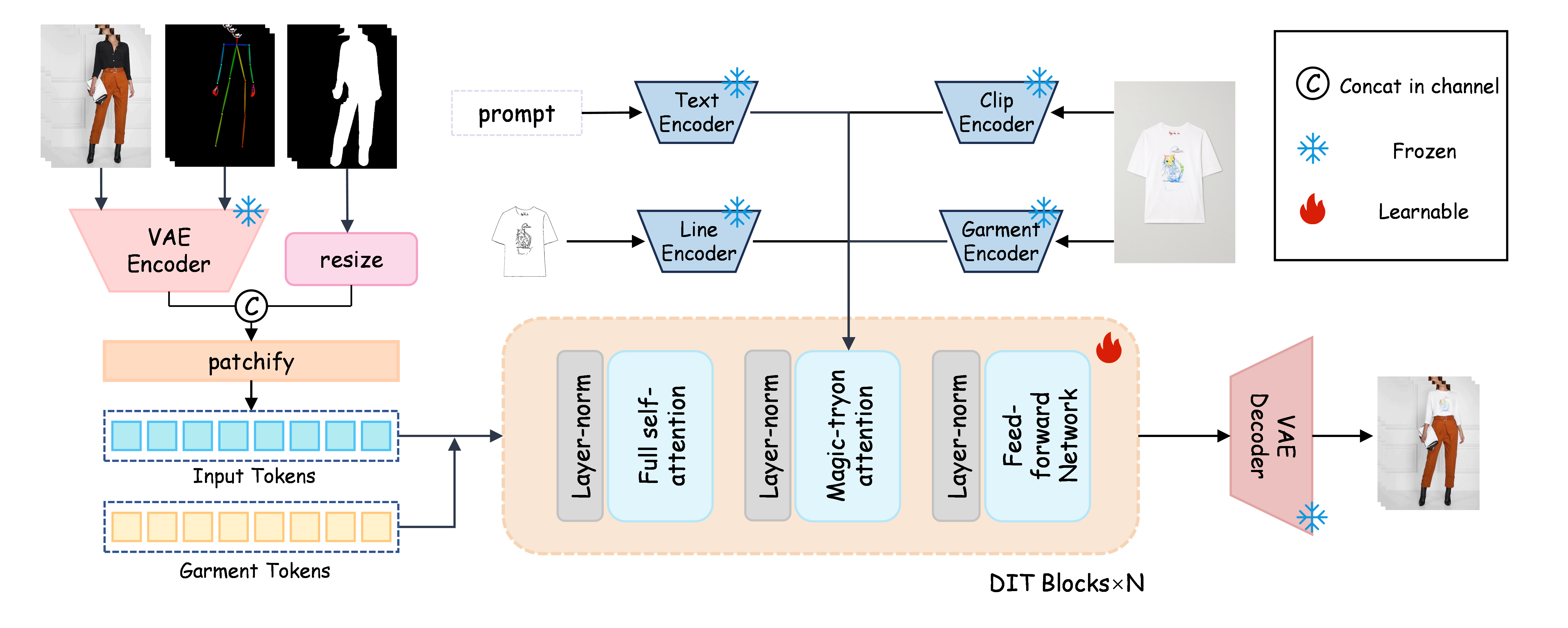
A coarse prior. A stronger baseline.
A human-mask prior preserves the scene without depending on brittle garment-level segmentation in every frame.
Inside TripVVT-10K
Triplets, not isolated frames.
Each sample pairs a canonical garment with an original video and its cross-garment try-on target.
03 · Results
Qualitative evaluation across benchmarks.
Compare garment fidelity, background preservation, and temporal consistency on TripVVT-Bench and VIVID-S-Test.
Limitations
Where the model still breaks.
Challenging motion, occlusion, and garment structures remain open problems. We include representative failures rather than hiding them.
Citation
Build on TripVVT.
If the dataset, benchmark, or baseline supports your work, please cite the paper.
@article{shao2026tripvvt,
  title   = {TripVVT: A Large-Scale Triplet Dataset and a Coarse-Mask Baseline for In-the-Wild Video Virtual Try-On},
  author  = {Shao, Dingbao and Wu, Song and Wang, Shenyi and Wang, Ye and Tang, Ziheng and Liu, Fei and Lin, Jiang and Chen, Xinyu and Wang, Qian and Tai, Ying and Yang, Jian and Yi, Zili},
  journal = {arXiv preprint arXiv:2604.27958},
  year    = {2026}
}